Least Privilege Data Access for AI Agent Fleets
Agents need time-limited, task-specific access scoped at both identity and data layers.
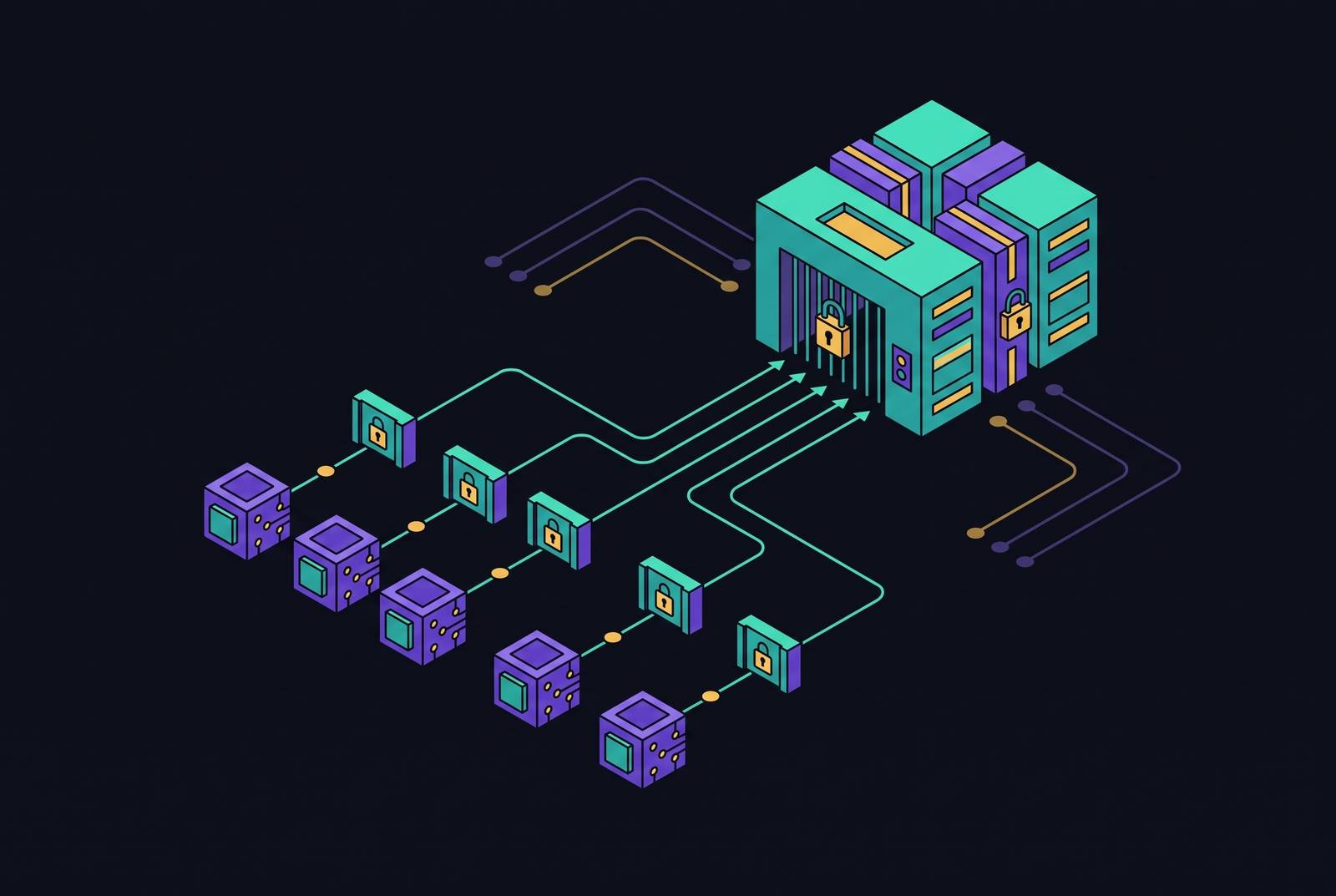
AI agents are not just faster API callers that sit behind a familiar access control checklist. They plan multi-step work, chain actions across systems, and invoke tools in sequences no human reviews one step at a time, and that breaks the authorization model built for human identities. Microsoft's own security research describes the resulting pattern: an agent granted read-only access for a legitimate task finds a path to write access somewhere downstream, often because a connected tool or a chained permission allows it, and no one designed the boundary to stop there. The scope grows quietly, task by task, and soon the agent holds far more reach than any single job ever required.
An attacker who can speak to the agent instead of to a system turns that accumulated scope dangerous. Prompt injection does exactly this: a payload hidden inside something as ordinary as a support ticket can instruct an over-permissioned agent to reset executive passwords or rewrite access control groups, and the damage stops only where the agent's reach stops. miniOrange calls this "the supercharged insider problem," and the description fits the mechanics closely. A compromised human insider still has to think, still has to type, and still moves at human speed. An agent does not pause to question intent, so when something goes wrong, the fallout spreads across connected systems in seconds, not the minutes or hours a human-driven breach usually takes.
The stakes compound once regulation enters the picture. If agents run against live production data without any scoping at the data layer, they create exposure under GDPR's handling of personal data and under the EU AI Act's data governance obligations for high-risk systems, which apply in full from December 2, 2027 for standalone systems and August 2, 2028 for product-embedded ones. None of this requires a sophisticated attacker. It only requires an agent that was handed more access than its task needed, on the reasonable but mistaken assumption that unused permissions are harmless until something activates them.
Least privilege for a non-human identity running at machine speed
Least privilege is an old idea: grant only the access a task needs, for only as long as the task takes, then take it back automatically. Applying that idea to an AI agent means scoping access to a specific task, bounding it in time, and reviewing it continuously instead of setting it once and forgetting it, replacing the broad, standing permissions typical of service accounts. The principle itself is not new. What changes is the machine doing the requesting, and the speed at which it requests.
Microsoft's framework draws a useful distinction here: time-limiting should apply to entitlements, like role activation, tokens, and approvals, while the agent's identity itself stays stable. The identity stays stable so it can be managed over its full lifecycle, tracked, rotated, and shut down cleanly, while just-in-time elevation grants a narrow, specific privilege only for the duration of one workflow and nothing beyond it. You need a named human owner for that identity, a stated purpose, and a working shutdown mechanism that actually revokes tokens, not one that just disables a login screen. Roles built for agents should map to discrete tasks, things like "read-only knowledge retrieval" or "create a draft ticket," rather than to teams or job titles borrowed from an org chart. Bundling unrelated permissions into one role because it's operationally convenient is precisely how the scope creep described above gets started.
The 2026 Singapore Consensus on AI Safety states the underlying principle directly: an agent's capabilities should be scoped to the minimum necessary for its current task and context, and that scope should adjust as the task itself changes. That moves least privilege from a static list of permissions assigned once at deployment into something closer to dynamic capability restriction, where any escalation beyond the current task requires explicit authorization rather than arriving automatically because a broader role allows it. miniOrange's 2026 analysis names three properties this requires that human identity management never had to enforce in the same way: access has to be task-based, changing with what the agent is actually doing; it has to be time-bound, expiring when the task ends; and it has to be identity-driven, with every action traceable to one defined identity. These are sound requirements, and they point to a real gap in how most organizations provision non-human identities today. But even a perfectly built role, perfectly time-limited and perfectly traceable, only governs which tools an agent may call. It says nothing about what happens once the agent is inside a live system and starts asking it questions.
Identity-layer limits on the data-access gap for agent fleets
Identity and role-based access controls answer one question well: who is this agent, and which tools can it invoke? They leave a second question almost entirely untouched: what does the data look like once the tool returns it? An agent with a cleanly scoped, well-audited, time-bound read-only role on a production database still sees every column that role can query, including personal data it has no task-related reason to touch, and still has the ability to run a query expensive enough to compete with the live transactional workload for locks and connection slots. The role was correct. The exposure happened anyway.
Research into user-authored permission policies for AI agents tests a related question: can a policy layer, written by the people closest to the system, constrain an agent's behavior at the level of individual actions? The value of that research is in showing where policy-based control reaches its ceiling, and that ceiling sits below the point where most of the real risk lives. Policies can say what an agent may do. They cannot fix what the underlying data actually means.
If "active customer" or "MRR" carries different definitions across different tables, an agent with entirely legitimate read access to production will still produce fast, confident, wrong answers, because nothing in an RBAC role or a JIT credential tells it which definition is the right one, and this is the metric-definition failure that governance at the data layer has to resolve. No identity control fixes a schema that was never built for analytical use in the first place. Compliance exposure follows the same path: agents querying live production tables without scoping at the data layer create unpredictable side effects, from unintended reads of GDPR-regulated personal data to audit logs that no regulator could reasonably interpret after the fact. Data minimization under GDPR Article 5(1)(c), which requires personal data to stay limited to what a given purpose actually needs, is not satisfied by a read-only IAM role if that role exposes personal data the agent's task never required. What's missing is a governed data artifact, built before the agent ever runs a query, so it pre-models and pre-scopes what the agent is permitted to see. Identity controls decide who gets to ask. Something else has to decide what gets answered.
How MCP wires agents to data systems
The Model Context Protocol, MCP, has become the standard way AI applications connect to outside tools and data sources, and its fast adoption means agent fleets are increasingly wired straight into production systems through one standardized, composable channel. That standardization is a genuine gain for engineering teams.
MCP separates the work into three layers: the AI client making requests, the MCP server handling connector logic, and the resource on the other end, typically a database or an API. Within that structure, tools are the executable functions an agent can call, resources are the data sources supplying context, and prompts are reusable templates for structuring a request. The specification published July 28, 2026 hardened authorization handling and introduced a stateless protocol core, and the engineering consensus that has formed around production deployments is specific: remote servers implementing authorization should use OAuth 2.1, PKCE is required for MCP clients using authorization code flows, hardcoded API keys are disallowed, and prompt injection defense, PII detection, and minimum-privilege token scopes count as mandatory input validation, not optional hardening. A widely cited practice for rolling MCP out in production is to start with read-only resource servers, exposing data for analysis through something like a read-first SQL tool, before introducing any write actions and only then with change approvals attached.
None of that protocol discipline touches the data itself. MCP does not make data correct, does not make it consistent, and does not scope it. If an agent connects through MCP to un-modeled production tables, it still returns confident wrong answers, still touches personal data it never needed, and still triggers the same query contention it would without MCP in the picture. MCP moves data to the agent faster. It was never built to make that data safe to move. Naming gaps, permission gaps, and conflicting metric definitions appear faster through MCP than through any interface that came before it, because agents generate and run queries at a volume no human analyst approaches, and the protocol exposes every governance failure at that same machine speed. MCP is the delivery mechanism. A well-governed data artifact served through MCP is safe to query, while a raw production schema served the same way becomes an amplified attack surface, and that governance layer sitting behind the MCP server is what the trustworthiness of the delivery depends on. That is why a governed layer behind the server is a requirement, not an optimization to consider later.
Governed datasets as the practical unit of least-privilege enforcement at the data layer
The right unit for enforcing least privilege in an agent fleet is a pre-modeled, pre-scoped dataset, built in advance, that defines what the agent is allowed to see, with its metrics already calculated to one agreed definition, served from a layer that keeps the agent away from production directly.
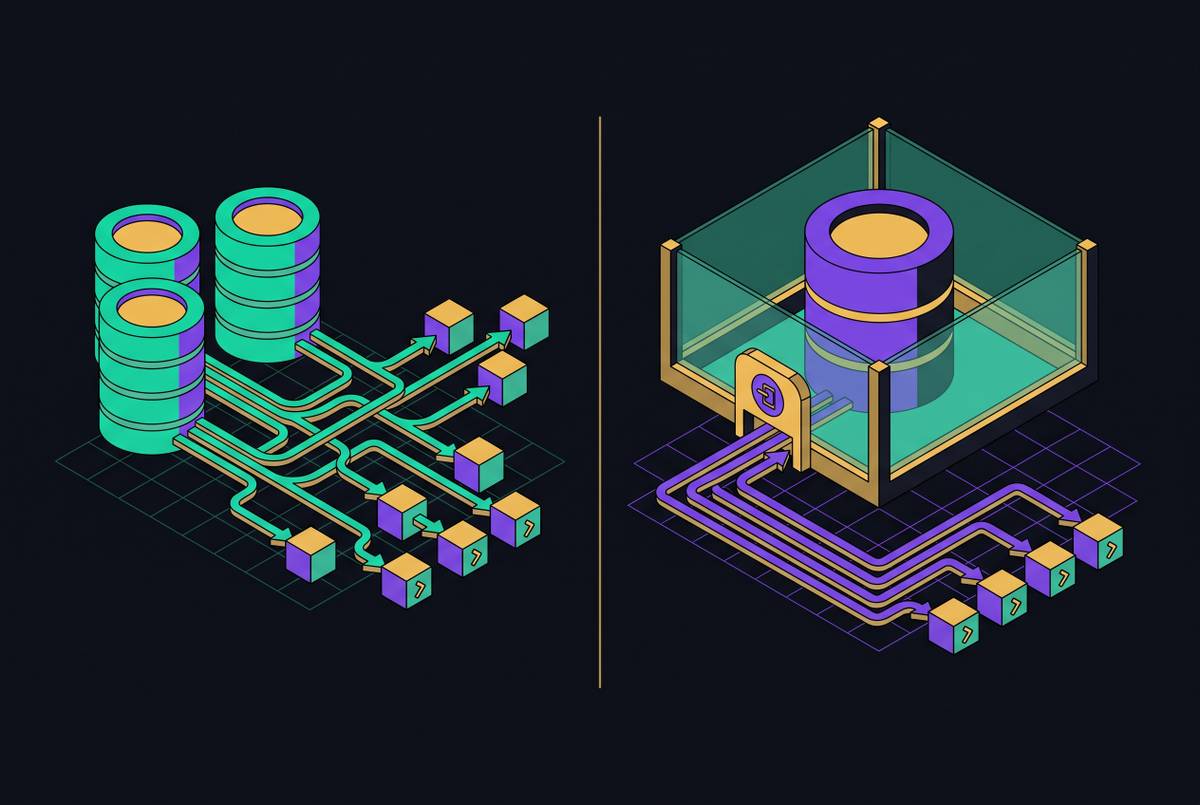
A governed dataset enforces privilege at three levels at once, where identity controls manage only one. Scope means the dataset contains only the columns, rows, and time ranges the agent's task actually requires, with personal data excluded by how the dataset was built rather than by a filter condition the agent could work around. Semantics means every metric is pre-calculated to a single canonical definition, so "MRR" means the same number to every agent and every human reading it, and the definition conflict that corrupts agent output gets resolved before any query runs, not after. Isolation means the agent queries a read-optimized artifact, Parquet files queryable through DuckDB or an equivalent engine, and never touches the production transactional database, which removes lock contention, connection slot exhaustion, and the risk of an agent-generated query damaging the system the business actually runs on.
This matters in a particularly direct way for teams building on Supabase. Supabase auto-generates a REST API straight from the Postgres schema, so every table becomes reachable the moment it exists unless Row Level Security is turned on; with no policies defined, access defaults to fully denied, and policies then selectively reopen it. Supabase's own documentation treats RLS as the essential control for protecting data, for a direct reason: the anon key shipped inside every client bundle is public by design, so anything RLS doesn't restrict is effectively open. For AI agents specifically, Supabase's guidance on retrieval-augmented generation with permissions confirms that fine-grained access control on vector databases can be built using RLS, limiting which documents come back from a similarity search to the users who are actually permitted to see them. Long-running OLAP-style queries hold locks, eat up connection slots, and compete for shared memory against the live transactional workload when heavy analytical queries land directly on a production Postgres instance. The standard pattern routes agent analytics to a read replica or a dedicated analytical layer instead.
Pre-calculated metrics do more than improve performance. They function as a governance control in their own right: an agent querying a pre-modeled dataset with one canonical definition of ARR cannot return a "wrong" ARR by picking a different calculation path, because the calculation happened once, through a governed process, long before the agent ever asked the question. This is the data-layer counterpart to the RBAC principle discussed earlier. Just as a role defines which tools an agent may call, a governed dataset defines which facts an agent may retrieve, and the dataset's schema effectively becomes the policy. Dreambase builds for exactly this pattern on Supabase and Postgres: it pre-models data into governed Parquet datasets queryable through DuckDB, exposes all of it through a single MCP server, and keeps agents from ever touching production directly, serving as a shared analytical layer for human teammates and AI agents alike, without ETL pipelines, a separate data warehouse, or any change to the production Postgres schema.
A least-privilege data architecture for a Supabase team deploying agents
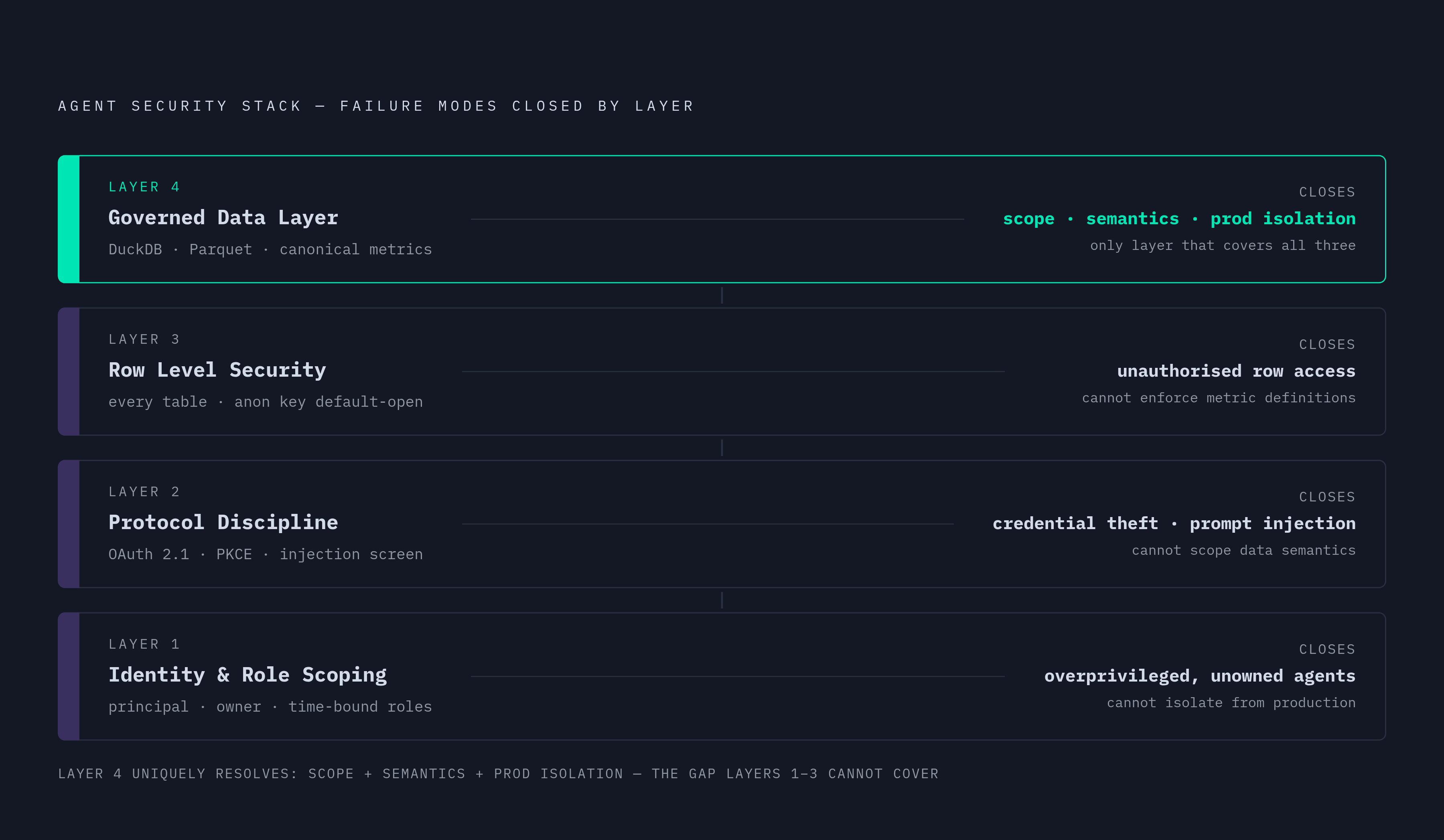
A workable least-privilege data architecture for an agent fleet running on Supabase rests on four layers, and leaving any one of them out reopens the exposure the other three were built to close.
The first layer is identity and role scoping at the agent level: a dedicated principal per agent, a named human owner, time-bound entitlements, and roles that map to specific tasks. The second is protocol-level discipline for however the agent reaches its tools: OAuth 2.1 for remote authorization, PKCE where authorization code flows are in use, no hardcoded keys sitting in a config file, and input validation that actively screens for prompt injection and PII exposure. The third is Row Level Security on every Supabase table an agent or its underlying service role can reach, because the public anon key and the auto-generated REST API mean anything not explicitly closed off is reachable by default. The fourth layer, which the earlier sections of this piece spend the most time on, is a governed data layer: pre-modeled, pre-scoped datasets with metrics calculated once to a canonical definition, served through read-optimized artifacts the agent can query without ever opening a connection to the production database itself.
Correlation risk is one reason this fourth layer carries so much weight. An agent with access to multiple live systems can join data across them and take actions no one individually authorized, a risk that grows sharply when each connected system is a full, unscoped production schema. Serving agents pre-modeled, scoped data instead of direct database access closes that path by construction: the agent's reach stays pinned to the dataset it was given, with no schema to explore and no ad-hoc joins across tables it was never meant to see. Each layer here handles a different failure mode, and none of the four substitutes for another. Identity scoping limits who can act and under what role. Protocol discipline limits how the agent connects and authenticates. Row Level Security limits what a given request can touch inside Postgres. The governed dataset layer limits what the agent is handed to reason over in the first place, resolving scope, semantics, and isolation all at once, before a single query ever runs against anything the business depends on.