Audit Trails as the Missing Accountability Layer When Agents Query Supabase Metrics via MCP
Supabase logs show what ran, not which person delegated it.
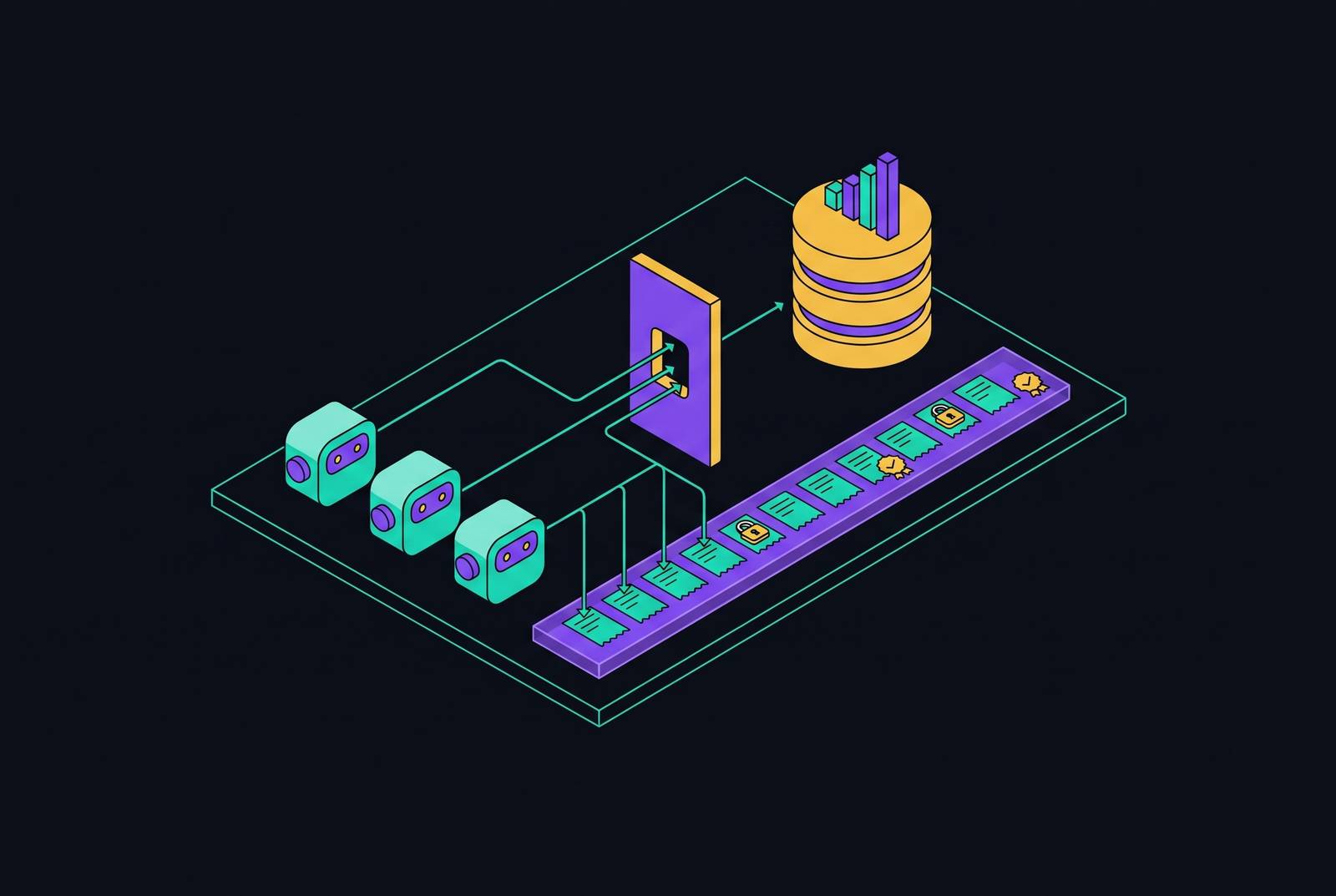
For governed data access for AI agents on Supabase via MCP, route metric queries through a governed data layer. That layer should serve pre-modeled metrics and write an independent audit trail linking the agent, its account, and the person who delegated the work. Database logs alone cannot show which person is accountable.
Why MCP queries create an accountability gap that standard Supabase logging cannot close
Every agent action involves three identities. The agent is the software making the call, the account is the OAuth token or service key authorizing access, and the person is whoever decided that the work should happen. MCP standardizes interactions through a client-server architecture, with tool use, resource access, and prompt templates as primitives. Those interactions identify software and credentials, but the protocol has no general field for the person behind an action. A record assembled from MCP messages therefore cannot, by itself, establish who delegated the work.
This is a protocol design boundary. A database can record the account that sent a query without knowing who wanted the agent to send it. More SQL detail does not reveal who that person was. The distinction becomes important when an apparently valid query needs to be explained.
The May 2026 MCP specification proposal points to similar gaps in what is known about security-sensitive tool calls, including database queries, file access, and administrative operations. It asks why the AI invoked a tool and which model produced the invocation. Without a standard place for that context, each implementation makes up its own tool arguments, so records differ across servers. Supabase receives the resulting database operation with an incomplete account of the decision that produced it.
What Supabase's native logging captures and where it stops
Supabase's native query logs record what ran and when. That makes them useful records of database activity, but not a durable, person-linked history of agent decisions. The supabase_query_logs tool exposes a query window of at most 24 hours per request. Overall retention depends on the plan. The Free plan has shorter retention that can shrink further in a degraded state, while higher tiers provide longer windows.
Row Level Security governs which rows an authorized request may access, but the service role key bypasses all RLS policies and provides unrestricted database access. That key is appropriate for schema migrations and administrative tasks and should be excluded from agent sessions interacting with user data or metric tables. A bug, unexpected input, or prompt injection can otherwise translate into corrupt production data.
Operational observability remains necessary despite these limits. A Postgres exporter, Realtime Prometheus metrics, and structured query-level logging provide visibility into latency and the database activity behind agent workflows. They supply the SQL-side records needed for later correlation with an agent audit event. However, neither longer retention nor RLS creates the missing person identity, and neither alone establishes accountability as more agents begin issuing requests.
How the absence of a person-identity field compounds into a governance liability as agent volume grows
With one agent, a missing attribution may look like an inconvenience. Each additional agent introduces more sessions and calls whose human origin must be reconstructed, increasing the burden on the team investigating them. Forecasts suggest that the number of agents will grow sharply, so tracing those links by hand will become harder to rely on. For startups, the exposure extends to business reporting. If agents can read and reshape metric tables without durable attribution, the resulting KPIs can become unreliable for investors, internal decisions, and future audits.
The ContextNest specification names the broader problem the context governance gap. Access to information does not establish that the information is approved, current, attributable, versioned, tamper-evident, and auditable. Its procurement example illustrates the consequence. An agent approves a vendor using an archived risk-threshold policy, and six months later no audit trail establishes which version it consumed. The same ambiguity applies when a definition such as monthly active users changes without a record tying the query to its definition.
The MCP approval flow documents an Alice/Bob phishing pattern in which Alice starts an approval, persuades Bob to complete authorization through a URL, and receives the resulting tokens. The CRM record and the MCP server record may both be right, yet neither explains what happened. An adequate audit architecture must therefore preserve delegation and causality alongside the name attached to a successful authorization.
What a purpose-built audit trail for MCP agent queries must record
A purpose-built audit event links the agent, the account, and the person who delegated the work. It also preserves the causal chain from human intent to tool execution, including the targeted application and the policy behind the authorization decision. These are distinct facts. An account establishes which credential was used, while the delegation record establishes whose instruction the agent was acting on.
The May 2026 proposal offers optional fields for that causal context. _meta.turnId groups requests from one user turn, _meta.userIntent records what the human asked, _meta.invocationReason explains the particular tool call, and _meta.model.name identifies the model producing it. Intent and invocation reason serve different purposes. A request to see a set of employees can generate several tool calls, each with its own reason. Recording only the executed SQL loses that relationship, while recording intent alone still does not authenticate the delegating person.
The ContextNest specification adds point-in-time reconstruction of the knowledge consumed and its eligibility for AI use. Applied to metrics, that means preserving the relevant dataset and metric-definition versions. Request and session correlation identifiers then join AI audit events to SQL service logs. Those events need independent retention. Supabase's 28-day Team plan retention cannot support a review extending beyond four weeks unless the required records are persisted elsewhere.
Why audit collection must happen at the infrastructure layer, not inside the agent
An agent's own reports cannot give an independent account of what it does. A compromised, misconfigured, or prompt-injected agent can omit, alter, or fabricate the records that would expose its actions. Collection must therefore happen outside the component being scrutinized. Otherwise, the audit depends on the same behavior it is supposed to assess.
The Redpanda Agentic Data Plane pattern records every agent-data interaction in structured transcripts collected by infrastructure. Metadata channels also control who can access the transcripts. A boundary that observes the interaction can record it without asking the agent to describe its own conduct.
Patent #12,562,968 establishes proxy-based secure MCP server access as a formally recognized gateway architecture. Such an intermediary provides a place to enforce access and record calls before allowing them to complete. The patent establishes architectural precedent, while each deployment's compliance with an audit standard requires its own proof. External integrity assurance remains necessary when the server being audited could itself be compromised.
Infrastructure collection does introduce operational work. Combining authorization and audit recording at the same enforcement boundary avoids treating them as unrelated processes. However, the MCP 2026-07-28 changelog describes per-request metadata and authorization hardening, while mandatory per-request authorization decisions and audit-event writing remain implementation responsibilities.
How can AI agents query Supabase metrics without direct database access?
A governed data layer separates agent metric queries from production Postgres. It exposes shared metric definitions and approved datasets through APIs and MCP, then records access at the serving boundary. The agent reaches the metric interface. MCP connects applications, while pre-modeled data gives them the stable definitions they need to make sense of the answers and audit them.
Headless analytics makes that separation practical. It decouples collecting and storing analytics data from the dashboard used to display it. A team can read a metric in a dashboard, code can retrieve it over HTTP, and an agent can consume it over MCP. All three use the same defined metric. The serving layer then becomes the common point for recording agent access.
For Supabase teams, the concrete pattern is governed Parquet datasets queried through DuckDB and exposed through a single MCP server. Agent queries stay off the production Postgres instance, so agents do not need a production service role key. Row-level access controls still belong among the criteria for the serving interface. Keeping agents off production prevents direct RLS bypass, but does not by itself define which governed rows each caller may receive.
Informatica announced fully headless data management through native MCP support at Informatica World 2026. It offers tools for metadata search, data quality checks, address verification, and MDM operations. That provides enterprise precedent for governed MCP endpoints. For this use case, the decisive criteria are production isolation, shared definitions, row-level authorization, and person-linked boundary auditing.
The governance principle that settles the read-only versus productivity debate
Read-only metric access does not require every agent workflow to be read-only. Practitioners object that useful work can require writes somewhere in the process, even when metric consumption itself is governed. That objection does not justify standing, unrestricted database credentials. The relevant distinction is between permission for a specific operation and broad authority that remains available between tasks.
The Coalition for Secure AI's April 2026 Agentic Identity and Access Management publication recommends Zero Standing Privilege principles. Under that approach, agents receive short-lived, task- and context-bounded entitlements rather than long-lived, broadly scoped access. The credential scope becomes part of the audit record. Where writes are authorized, correlation identifiers can still connect the human's request, the agent run, and the SQL-side operation.
Log ingestion, retention, and query access should be partitioned so that the agent's operational permissions do not also control its audit records. This distinction prevents a readable transcript from being mistaken for an independently protected audit trail. The permission decision and its record must remain separate from the agent's ability to use a tool.
The governing principle is straightforward and compatible with productivity. Connection to a tool does not grant permission to execute it in every context. A governed layer can serve read-only metrics while task-scoped authorization lets agents make allowed writes elsewhere. Existing infrastructure patterns provide a starting point, so teams do not need to invent the entire architecture themselves.
What Supabase teams should put in place before their agent count grows
For teams putting this architecture in place, the sequence starts with credentials. Agent sessions that work with user data or metric tables should never use the service role key. Removing that access addresses the broadest exposure before a complete audit system exists. Where tasks need additional authority, short-lived, task-constrained credentials provide a narrower alternative. Their scope should be recorded with the action they permit.
The next step is SQL-side observability. Structured logging, a Postgres exporter, Realtime Prometheus metrics, and query-level records provide the database records needed to correlate an agent action with its effects. Audit events should then be persisted independently of Supabase's native retention. The retention policy should be determined by the team's compliance and investigation needs independently of its database plan tier. A 28-day window is not an audit archive.
Once those records are in place, metric queries should go through the governed serving layer. The boundary should record all three identities and the causal context supplied with each request. Metric definitions should become first-class governed artifacts with version histories and eligibility checks. This lets a later review establish which definition was current when an agent queried it, rather than judging the result against today's definition.
Protocol alignment supports this work but does not complete it. MCP revision 2026-07-28 provides per-request version and capability metadata in _meta, together with OAuth 2.0/OIDC authorization alignment. Teams still need to implement delegation attribution, enforcement, and independent audit retention around that foundation. Closing the gap early prepares the records regulators and investors will need when they ask who decided what the agent did.