The MCP Analytics Server as the Sole Emission Point for Agent-Visible Supabase State
An MCP server can govern what agents see and what answers mean.
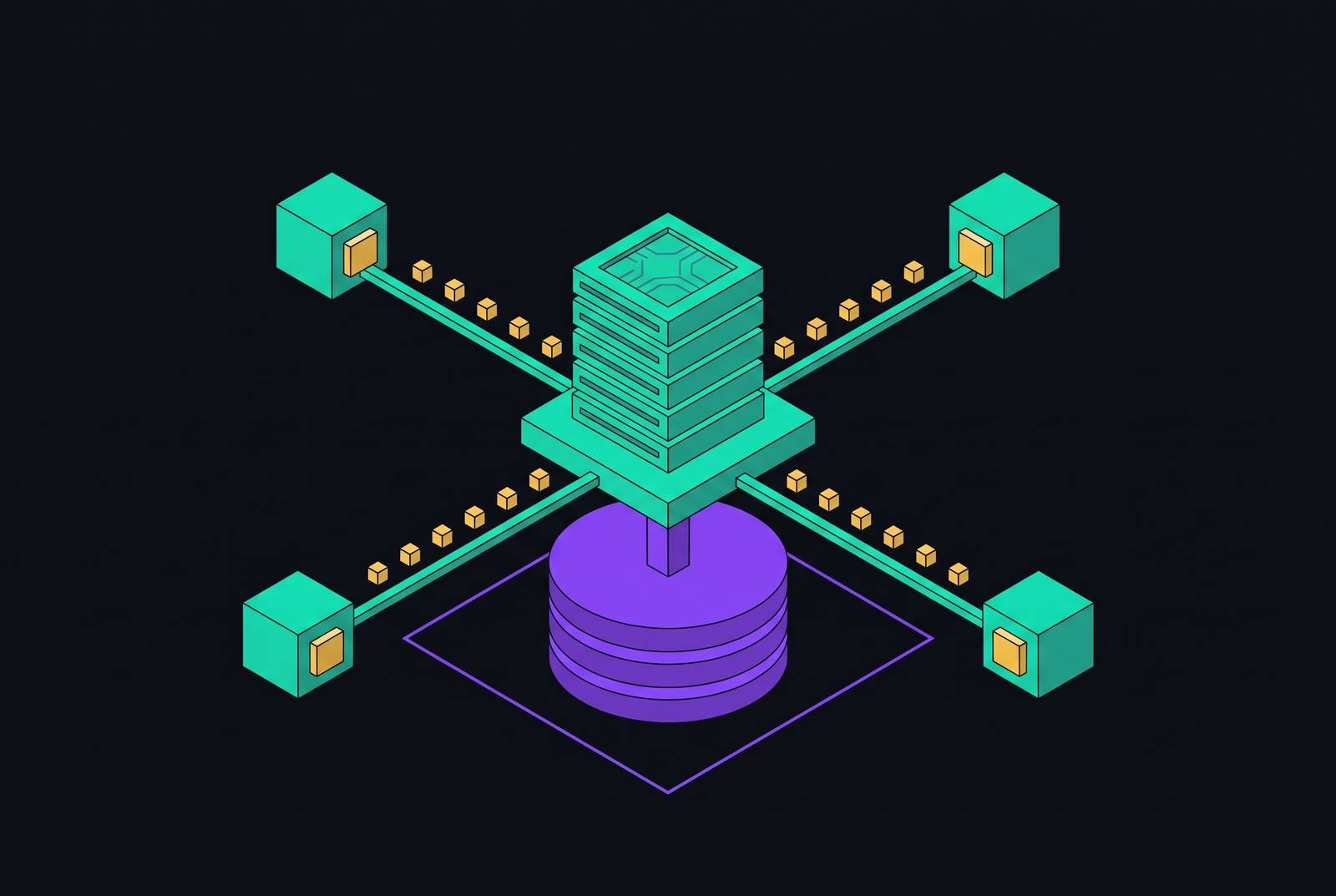
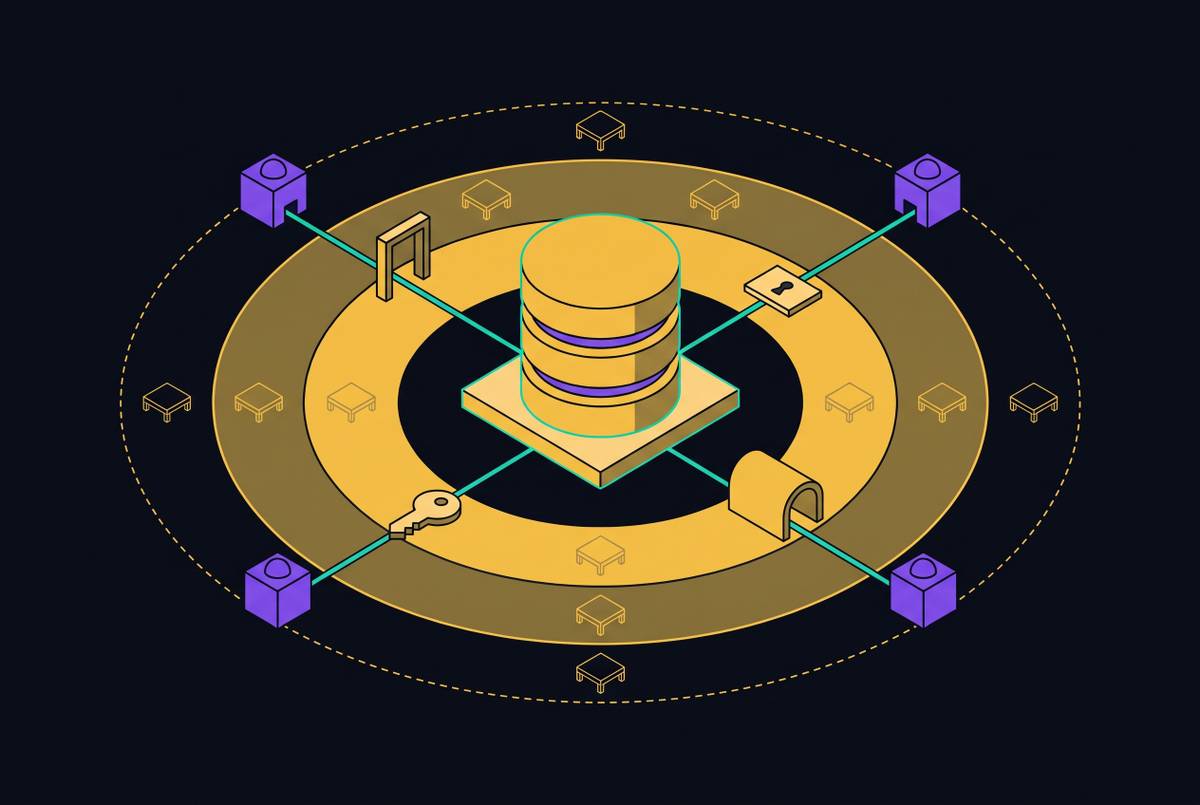
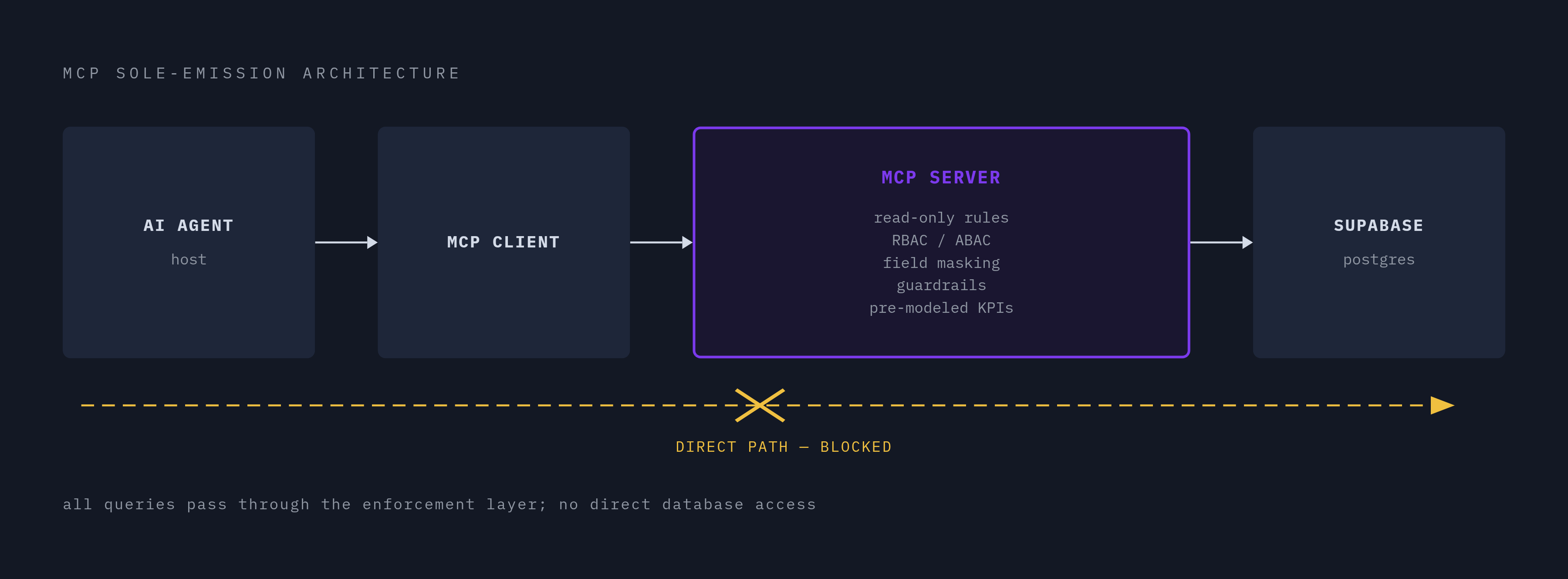
To give AI agents governed access to Supabase without direct database credentials, make an MCP analytics server the only way they can reach pre-modeled, read-only datasets. Enforce access controls there and limit exposure to canonical metrics. This sole-emission-point design turns scattered permissions into a deliberate architecture for controlling both what agents can see and what their answers mean.
Why AI agents querying Supabase Postgres directly creates a structural problem
When product data sits in Supabase Postgres with key fields buried in JSONB, a familiar workaround is a personal ChatGPT project that generates extraction SQL. Five people maintain five slightly different extraction queries and get five slightly different numbers. The discrepancy begins before anyone interprets the results. Each query embeds its own understanding of how the product stores data, leaving the team with competing calculations. An agent reproduces this problem without the social accountability that might bring a human’s extraction logic under review.
Direct production access also puts analytical exploration on OLTP compute. Read-heavy queries consume pooler capacity, encounter friction from RLS policies, and work against JSONB-heavy schemas that resist the columnar access analytics needs. Production and analysis compete for the same resources. Permission does not establish that the query is suitable for the workload or that its extraction logic produces the intended business number.
These failures reinforce each other as agents explore. As agents try more ways to understand the schema, the database does more work, but access to more schema elements may not improve the answer. A team can authorize every request correctly and still get costly, inconsistent analysis. That is a structural mismatch between an operational database and the analytical interface an agent needs.
What MCP is and why its three-layer architecture creates a natural chokepoint
Anthropic released the Model Context Protocol in November 2024 as an open standard for connecting AI models to external data sources and tools. Its architecture separates three roles rather than treating the model and database as a single integration. The host is the AI-driven application. A client inside that host maintains one connection to one MCP server, while the server is a lightweight service that exposes data or capabilities through the protocol.
The server exposes three distinct primitives, which are resources, prompts, and tools. Resources supply structured context data, while prompts supply predefined instruction templates. Tools are executable functions the model can invoke, including functions that query a database. The query path is therefore explicit and inspectable. In an analytics integration built around tools, the client sends the invocation to the server rather than giving the model an independent database connection.
Connector logic can be written once and reused across agent integrations by MCP-compatible clients. Without a shared server, teams have to enforce access rules in separate places for each set of connectors and credentials. MCP provides the common interface, but it does not make that interface exclusive by itself. The architectural decision is to make every agent query use it and leave no parallel route to Supabase state.
How do you let AI agents query Supabase without direct database access?
AWS’s reference architecture, published November 6, 2026, shows how the governed-server pattern works for a data lake. A FastMCP server on ECS Fargate gives agents access through a SQL tool that enforces read-only queries before they reach the data layer. Bedrock Guardrails apply to all LLM interactions at the MCP server layer rather than being configured separately for each agent. Enforcement sits on the shared request path. The example provides a concrete model for the boundary a Supabase analytics server should establish.
If an agent can bypass the server through another connector or database credential, the MCP policy governs only one route. When the server is the sole emission point, its controls apply to every agent-visible representation of Supabase state. Teams build access policy into the shared interface. A read-only restriction is then a tool-level rejection rule.
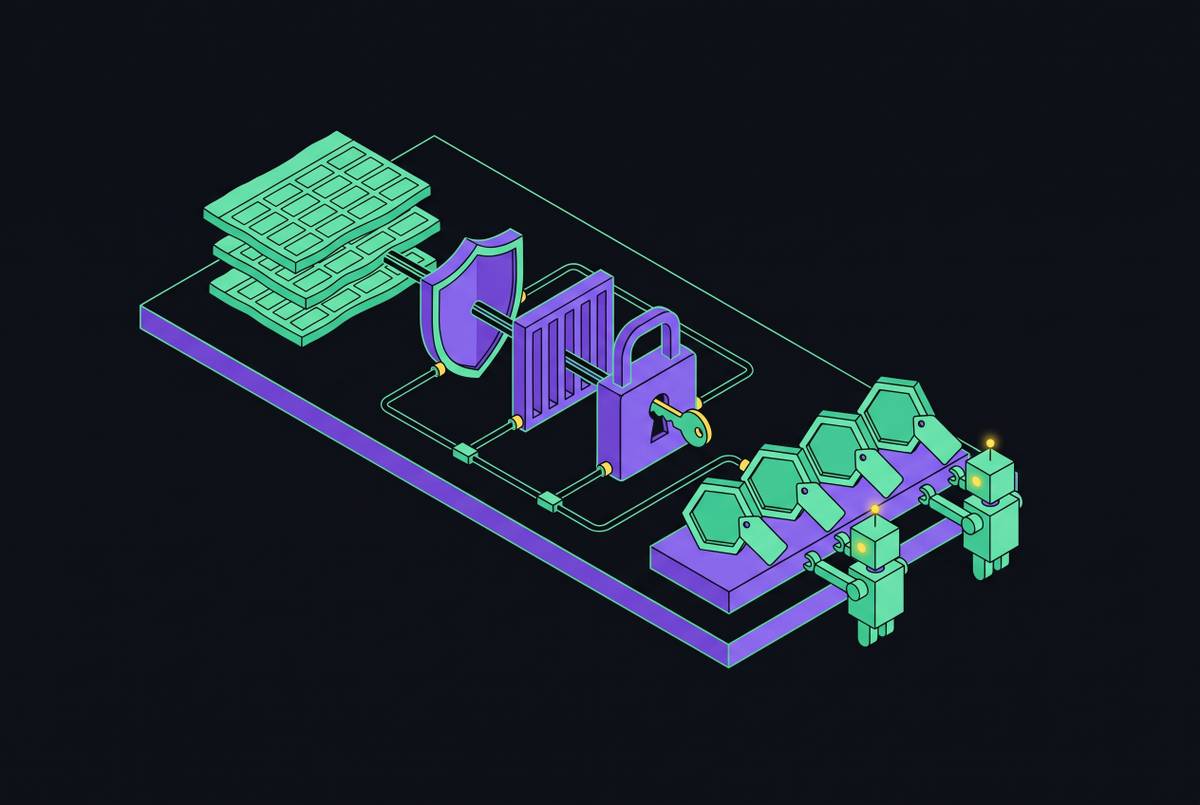
That shared boundary can mask sensitive fields before returning data and use RBAC, ABAC, and identity-and-access-management-to-MCP mapping to govern which identities may invoke which tools. In the AWS pattern, onboarding a dataset requires only an edit to one JSON file containing schema, business context, and column semantics. Metadata becomes part of the audit surface. Together with guardrail configuration, it records what agents should be able to access so teams can review access as they design it, though they still need to monitor what runs.
Why pre-modeled, governed datasets behind the MCP server produce more accurate agent answers than raw schema access
Sophrosyne, the May 2026 paper, classifies Supabase as a fine-grained API surface and identifies a specific failure in agent exploration. Fine-grained APIs encourage agents to incorporate irrelevant schema elements into query formulation, degrading SQL generation accuracy. More schema access can make answers worse. The paper proposes augmenting API responses with directives that constrain exploration, and its results show reduced over-exploration and improved accuracy. It frames API granularity as a cost-accuracy tradeoff.
The server can offer semantically defined datasets, metric definitions, and pre-calculated outputs instead of asking an agent to take more care as it explores raw tables. The agent has less interpretation to perform. This is a stronger architectural response to inconsistent extraction logic, although it is not the intervention tested by the paper. It moves the responsibility for defining analytical data from each generated query into the dataset itself.
For teams adopting this design, the recommended sequence is metadata plus one KPI tool before open SQL. That sequence establishes analysis access. It also gives the first tool a bounded purpose and a defined output before expanding the agent’s query surface.
What the agent-to-data safety problem looks like as agent tool use shifts from read to write
A Formal Security Framework for MCP-Based AI Agents reports on a large study that examined tools in public MCP server repositories between November 2024 and February 2026. The proportion of action tools, which modify external environments, rose from roughly a quarter to 65% of all tools. Read-only access is no longer the assumed interaction. An analytics server that exposes only governed, read-only representations keeps its access boundary stable even as the agents using it acquire broader capabilities.
Databricks reports that a large majority of databases provisioned on Neon are created by AI agents. That provisioning signal reinforces the growing role of agents in database infrastructure. For a Supabase team, the design question is how to separate analytical access from capabilities that change state. The sole-emission-point pattern answers it before an agent-initiated write reaches production, rather than relying on each increasingly capable agent to remain within an advisory boundary.
Why Supabase Postgres observability is a prerequisite for knowing whether the chokepoint is working
A governed query can still be a slow query. Installing an MCP analytics server without Postgres observability leaves the team unable to distinguish controlled access from an operationally healthy workload. The server provides a place to intercept requests, while database signals show the cost of the work underneath. A tool-level policy says what may execute, but it does not establish that production can absorb the resulting load.
Supabase turns on pg_stat_statements by default on every project, so teams can see each query’s mean time, total time, and call count. Those measurements form the foundation of query monitoring and an early signal of misbehaving agent-generated queries. Repetition can be as important as individual query duration. A query that appears acceptable in isolation can still contribute substantial total work when agents invoke it repeatedly.
For teams implementing the design, the minimum viable observability stack is pg_stat_statements and auto_explain enabled, with one alert per critical signal. This captures most of the value of database observability at almost no infrastructure cost. The broader recommendation adds Postgres exporter, Realtime Prometheus metrics, and structured logging from day one, with p50/p95 latency dashboards as agent query volume grows. The MCP server is the enforcement point for thresholds before agent-initiated query storms reach the production primary. Its controls and Postgres health signals must be considered together, rather than treating successful tool calls as proof that the boundary is working well.
How the metrics layer behind the MCP server becomes the single source of truth for both humans and agents
A server can faithfully enforce permissions while exposing several incompatible calculations of the same KPI. The metrics layer closes that gap. Also called a metrics store or headless BI, it standardizes how a company calculates its metrics and provides the canonical definition for each KPI. “Revenue” then means the same thing whether a human or an agent asks, because both consume the same defined calculation.
This consistency requires ownership as well as modeling. Every critical KPI needs a business owner responsible for its definition and a data owner responsible for its calculation. The responsibilities are distinct but must stay connected. A technically correct calculation can still express the wrong business definition, while an agreed definition is not useful if the implementation computes something else. Adopting a new BI platform does not by itself resolve that ownership problem.
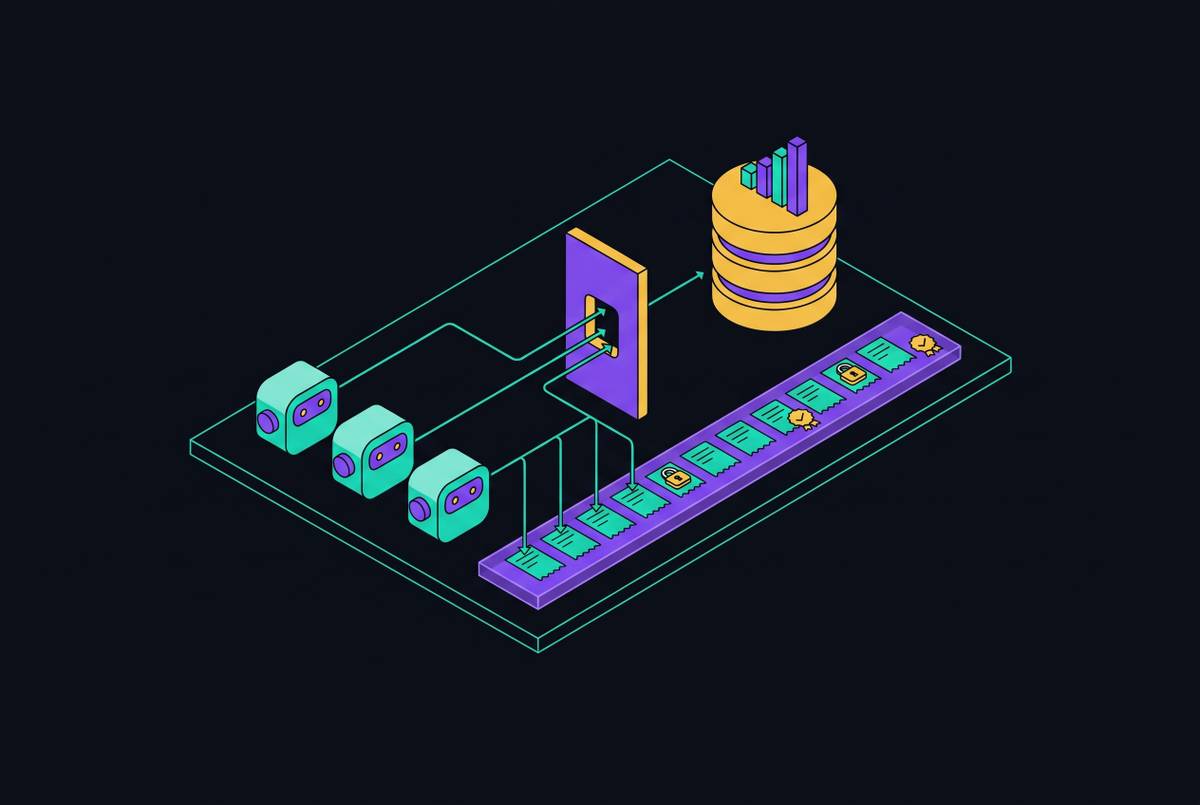
The MCP server should expose this shared analytical substance rather than becoming another place where definitions diverge. Pre-calculated metrics give agent tools a contract they can count on, and interfaces that people use can still draw on the same metrics layer. No single front end owns the definition. This headless analytics pattern decouples data infrastructure from its presentation and makes the same governed outputs accessible through MCP or an API. Metrics can then be pushed to an inbox, Slack, or dashboards rather than depending on someone remembering to request them.
Humans and agents may ask in different ways, but neither needs to reconstruct the calculation from JSONB fields. The modeling work is shared across those consumers. That is what makes the server useful beyond access enforcement.
The strongest objection to sole-emission-point design and what it actually means for teams that adopt it
The strongest objection is that a single chokepoint can become a bottleneck and curated datasets can prevent agents from answering novel questions. That tradeoff is real and deserves explicit acceptance. Sophrosyne frames API granularity as a cost-accuracy tradeoff, and a server limited to curated metrics chooses consistency over unrestricted exploration. An unanticipated question may require data or relationships outside the exposed datasets.
The five core KPIs, operational thresholds, and metrics on the CEO dashboard benefit from pre-modeled datasets that answer faster and more consistently than fresh schema exploration. Novel questions are the edge case in that pattern. The sole-emission-point design is therefore the recommended starting point. As scale and trust mature, the surface can widen while keeping access subject to an explicit design decision.
Centralized enforcement also makes diagnosis more focused, although it does not eliminate availability risk. The metadata and guardrail configuration give reviewers a defined audit surface, and the AWS pipeline design uses separate checkpoints to localize failures. A single boundary still needs operational scrutiny. Access, meaning, and enforcement have identifiable places in the architecture.
Sources
- Sophrosyne: Agentic Exploration of Relational Data Systems Needs Moderation
- A Formal Security Framework for MCP-Based AI Agents: Threat Taxonomy, Verification Models, and Defense Mechanisms
- Architecture overview - Model Context Protocol
- Architecture - Model Context Protocol
- Serverless MCP server for AI agent data lake access on Amazon ECS Fargate
- Secure AI agent access patterns to AWS resources using Model Context Protocol